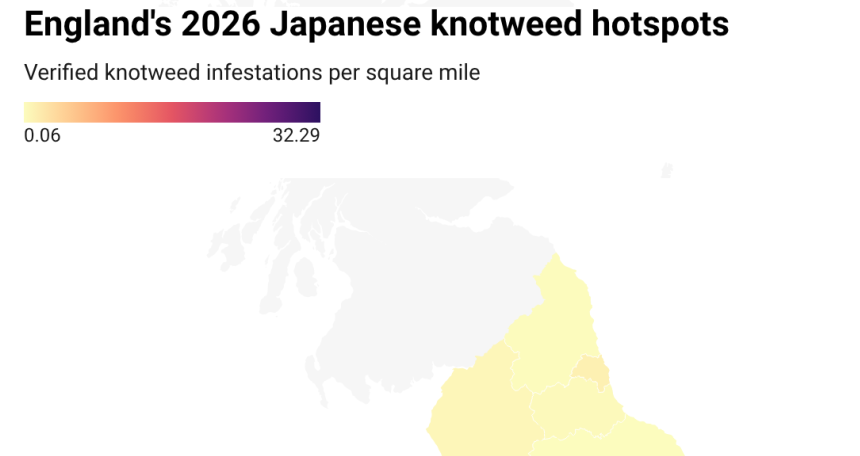
Environet has revealed the country’s Japanese knotweed hotspots for 2026 based on more than 100,000 verified sightings from its live online tracker, Exposed: The Japanese Knotweed Heatmap, highlighting where homeowners and buyers are most likely to encounter the invasive plant.
Bristol remains the Japanese knotweed capital of England due to its exceptionally high concentration of infestations, with 32.29 incidences per square mile – more than twice the density of second-placed Merseyside. Greater London is third this year, ahead of Greater Manchester and Lancashire. Knotweed is now present in every county of the UK, with an average of 1.1 occurrences in every square mile of England and 3.9 in Wales, impacting an estimated 1.58 million homes across the country.
The rankings are based on invasive plant specialist Environet’s own enquiries, public sources and verified sightings submitted by members of the public using the map’s ‘Add Sighting’ feature. Homeowners and homebuyers can enter their postcode to discover the number of known sightings within a five-mile radius, with hotspots highlighted in yellow, orange, or in the worst cases, red.
Taking into account the size of each county or unitary authority, the analysis highlights where Japanese knotweed is most densely concentrated and posing the greatest threat to homeowners, rather than simply where the most sightings have been recorded.
Introduced to Britain as an ornamental garden plant in the Victorian times, Japanese knotweed has since spread across the country through the movement of contaminated soil, waterways and more than 150 years of industrial activity, construction and infrastructure works. Former docklands and industrial areas dominate the hotspot rankings, highlighting the role these activities have played in aiding its spread. Knotweed does not reproduce by seed in the UK since all the plants are female, but its root system can extend up to 7 metres laterally beneath the ground and once established, even tiny fragments of rhizome can regenerate into new plants.
If left unmanaged, knotweed can cause damage to buildings, hinder property sales and lead to legal disputes if it spreads across property boundaries. Research conducted by Environet in partnership with Censuswide in January 2026 indicates that 7% of the UK’s homes – more than 1.58 million properties – are impacted by the invasive plant. Property values are typically reduced by around 5%, equivalent to £13,500 per home, highlighting the significant impact on the nation’s housing wealth.
After the fungus Hymenoscyphus fraxineus, which causes ash dieback disease, Japanese knotweed is the UK’s second most costly invasive non-native species, responsible for an estimated £246.5mn in annual economic costs according to CABI.
Environet Director Emily Grant said, “Japanese knotweed is now firmly established across England, with former industrial and port areas recording by far the highest concentrations. While there are significant hotspots in the south such as Bristol and London, the north of England accounts for more than half of the top 20 hotspots by infestation density.
“My advice to anyone living or buying a home in a Japanese knotweed hotspot is to familiarise yourself with what it looks like and check your garden regularly during the growing season. At this time of year, an established knotweed plant can be identified quite easily by its hard bamboo-like canes and distinctive bright green shield-shaped leaves which grow in a zig-zag pattern along the stem.
“The earlier it’s spotted, the easier and cheaper it is to deal with, and with a professional treatment plan in place homeowners have a much better chance of preserving the value of their property.”
Anyone who suspects they may have knotweed on or near their property can email a photo to Environet at [email protected] for free identification. If confirmed, a survey will determine the extent of the infestation, the risk of damage or encroachment and the most effective way to treat it.
Advice: How to spot Japanese knotweed during summer
- Tall, upright canes which can reach 2 to 3 metres high
- Dense clusters of stems emerge from a central crown in the ground
- Large green shield-shaped leaves with a pointed tip grow alternately up the stem
- By late summer, cone-shaped tassels of small creamy-white flowers emerge on the upper canopy
